
PRODUCT
CVP Equipment Vibration Protectors
A superby simple solution to keep your cables free from vibration and electrical distortoin
Why you need an CVP
Maintain Signal Integrity
Prevent floor induced vibrations and electromagnetic field potentials from disturbing signal integrity.
Mechanical Vibration Decoupler
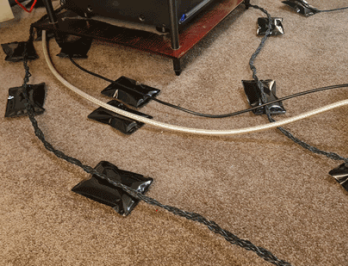
The CVP core is a soft fiberglass mechanical vibration decoupler. Typical cable lifters elevate, yet still allow vibrations to be transmitted to the cable through the lifter itself. With CVP, the cable and the floor are mechanically decoupled.
Electromagnetic Coupling/Isolator
The CVP EC jacket is an electrical field coupler. This housing prevents the electrostatic field from being generated when cables are elevated off the floor. With CVP, the cable and the floor are electrically coupled.
The CVP EI jacket is an EMI/RFI insulator. This prevents field coupling and is used to isolate cables from other cables and/or power supplies.
What CVPs do
The CVP design addresses both the physical vibration issue (with layers of fiberglass that transform mechanical energy into heat energy as the fibers move against each other, just as EVPs do), and the electrical distortion issue (by incorporating an electrical coupling or insulating material as the fiberglass jacket).
The CVP EC is both a vibration decoupler and an electrical coupler. As can be observed in measurements, the static electrical charge is zero, as well the capacitance when the cable is in contact with the CVP, and the CVP is in contact with the floor. Upon raising the cable off of the CVP, the electrostatic units (Kv) and capacitance units (F) increases with distance (or at least the 4” used when measuring). By placing the cable on the CVP you have formed a mechanical vibration isolator and an electromagnetic coupler. The EI version eliminates electromagnetic interference from entering your cable from adjacent sources like power supplies or other signal cables.
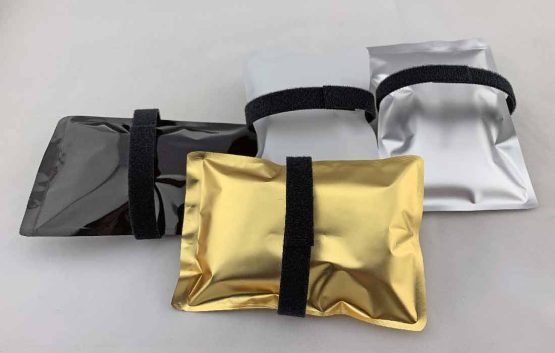
Another design goal of the CVP was to make it work without the cable falling off the device and/or the device falling over, unlike most of the competition, which is situated precariously holding the cables, and also creates a tripping hazard. This is accomplished by incorporating a Velcro strap to go loosely around the cable and the CVP. Typically (depending on the stiffness and weight of the cable), one CVP EC should be applied every 2-3 feet to keep the cable from contact with the vibrating floor, or one CVP EI where cables cross another or are in close proximity with a power supply, etc.
CVP Options and Sizes
Electromagnetic Coupler (EC) Version
Available in Four Colors and are 3.5"x5"x1"
Gold
Silver
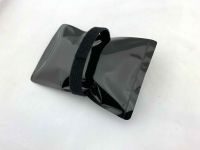
Black
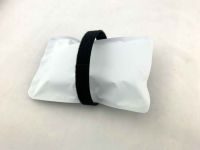
White
Electromagnetic Isolator (EI) Version
Available in Two Sizes-3.5"x5"x1", and 2.5"x4"x1":
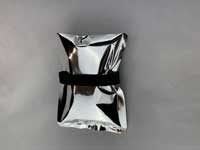
EI
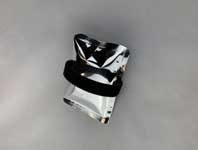
EI Mini
Reviews

"... cable risers don't really address the inherent problems faced by cables simply lying on floors, and especially don't do anything for vibrational and electromechanical issues. "
"AV RoomService CVP-ECs: Cable Vibration Protection for a Lower Noise Floor"
11-12-2019 | By Tom Gibbs | Issue 106
"I have spent many years attempting to improve how my speaker and power cables perform after noticing that I could get a temporary improvement by lifting cables off the floor and letting them rest down. This indicated EMI/RF and/or microphonic interference was impacting my cables. I have tried both proprietary and home-made cable risers and found limited improvement until I purchased and installed CVPs."
"Wow - the improvement is huge. The noise floor of the system has dropped markedly, as well as bass, microdynamics, image depth/width have all improved. Don't be put off by the humble look of these CVPs... they are absolutely outstanding and come highly recommended if your looking to get the best out of your system."
2022 | By Andrew C. | Australia